


1. WHAT IS NANOBUBBREVIATION TECHNOLOGY?
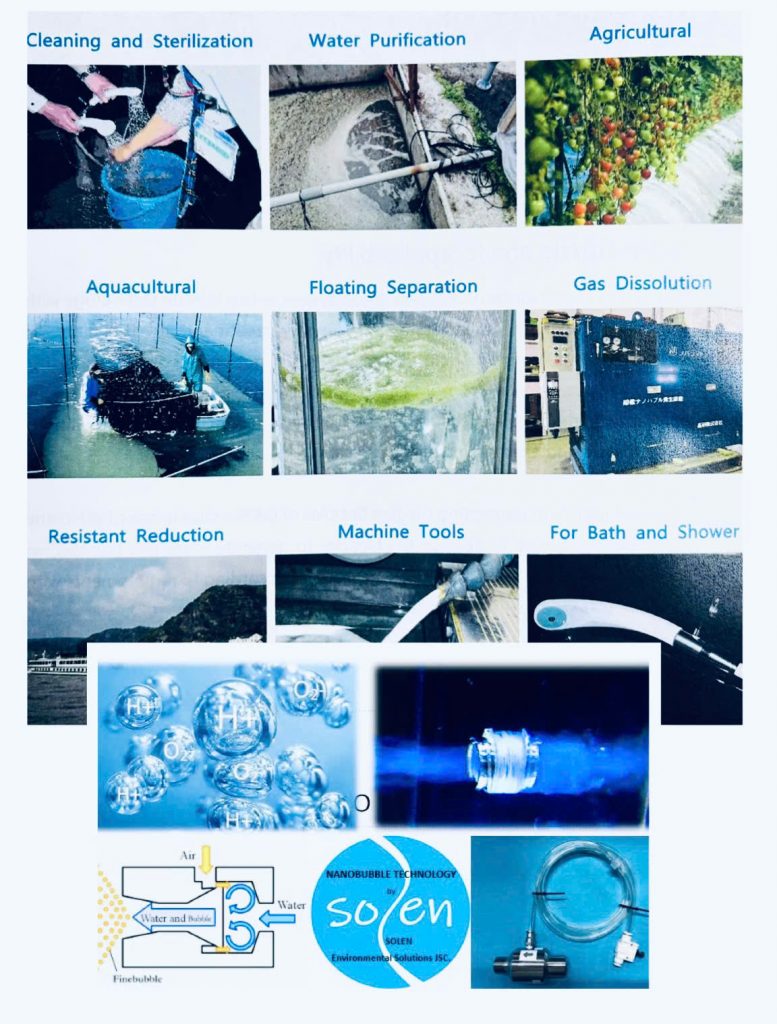
Nanobubble technology is the process of creating extremely small bubbles, ranging from a few tens to a few hundred nanometers in size. Thanks to their ultra-small size, these bubbles can remain in water for a long time, are evenly distributed, and are highly effective in gas exchange, oxidation, and water treatment.
Compared to conventional bubbles, nanobubbles:
Do not quickly rise to the surface, remaining in water for a long time;
Increase gas dissolution efficiency, reducing energy loss;
Reduce the need for chemicals in water treatment, agriculture, and aquaculture, etc.
2. FORMATION AND DEVELOPMENT WORLDWIDE
Nanobubble technology has undergone more than 70 years of scientific research, from theory to practical application.
2.1 Key Historical Milestones
1950–1980: Theoretical research on air bubbles, gas dissolution, and cavitation in liquids in Europe and the United States.
1990–2000: Observation of nano-bubbles using atomic force microscopy (AFM) and nano-particle analysis equipment.
2000–2010: Development of active nano-bubble generation methods; testing of applications in water treatment and aquaculture.
2010–2020: Technology commercialized and expanded globally.
2020–present: Became a strategic technology for sustainable development in agriculture, aquaculture, and environmental treatment.
3. CURRENT STATUS OF NANO-BUbble TECHNOLOGY APPLICATIONS WORLDWIDE
3.1. Europe
In countries like Germany, the UK, and France, nanobubbles are applied in:
Industrial and municipal wastewater treatment: removing pollutants, reducing odors and microorganisms
Water reuse: supporting water circulation in factories, reducing resource consumption
Sustainable agriculture and aquaculture: increasing dissolved oxygen, reducing chemicals and pesticides
Europe focuses on integrating nanobubbles with green development policies, creating comprehensive solutions that are both effective and environmentally friendly.
3.2. United States
The United States leads in the research, invention, and commercialization of nanobubbles, with hundreds of related patents. The technology is applied in:
Clean water and industrial wastewater treatment
High-tech agriculture
Biomedical and biotechnology: disinfection, improving cell culture environments
The equipment, process, and solution models in the US enable the effective application of nanobubbles on an industrial scale. 3.3. Asia
Japan
Pioneering the application of nanobubbles in aquaculture, hydroponic agriculture, and water treatment
Increasing dissolved oxygen, reducing disease, and improving aquaculture productivity
South Korea
Developing high-efficiency nanobubble generators for industrial and environmental applications
Increasing agricultural productivity and urban wastewater treatment
China
RAPIDLY INCREASING RESEARCH AND PATENTS
APPLICATIONS IN WATER TREATMENT, aquaculture, agriculture, food, and biomedicine
DEVELOPING INVESTMENT-SIZED PROJECTS
Southeast Asia
Countries such as Thailand, Indonesia, and Vietnam are applying nanobubbles in aquaculture, increasing dissolved oxygen and reducing disease.
Nanobubbles are becoming a global technology trend, from scientific research to commercial applications, with high adaptability and sustainable effectiveness.
4. VIETNAM IN THE GLOBAL DEVELOPMENT TREND
In Vietnam, nanobubble technology was adopted later but is well-suited to the practical conditions and production needs. Currently, nanobubble technology is still very new in Vietnam. Some places claim to have used nanobubble technology, with applications focusing on:
Aquaculture (shrimp, fish)
Pond water and wastewater treatment
High-tech agriculture
Proven practical benefits include:
Increased dissolved oxygen in water
Improved living environment for livestock
Reduced use of chemicals and pesticides
Enhanced efficiency and sustainability of production
Vietnam is entering the research – application – optimization – expansion phase, creating a market foundation for nanobubble technology. Although some places have claimed to be using nanobubble technology, ensuring that the bubbles are created at the nanoscale requires specific measurement solutions. However, to SOLEN’s knowledge, no unit in Vietnam currently has the capability to do so. Therefore, whether nanobubble technology has been applied in Vietnam remains an open question.
5. SOLEN – A PIONEERING UNIT IN APPLYING NANOBUBE TECHNOLOGY IN VIETNAM
SOLEN is one of the pioneering units in Vietnam in researching, applying, and implementing nanobubble technology in practice.
SOLEN focuses on:
Researching and mastering technology, optimizing solutions suitable for Vietnamese conditions.
Applying nanobubbles in water treatment, aquaculture, and high-tech agriculture.
Bringing significant improvements in water quality, production efficiency, and environmental sustainability.
As a pioneer, SOLEN helps bring nanobubble technology from theory and experimentation to practical application, suitable for the Vietnamese market.
6. CONCLUSION
From theoretical research over 70 years ago, nanobubble technology has become a global solution, widely applied in Europe, the United States, Asia, and is gradually asserting its role in Vietnam.
As a pioneer in Vietnam, SOLEN contributes to bringing nanobubble technology into practice, aiming towards a green, efficient, and sustainable future of production.
📚 REFERENCES
Nakagawa, T. & Setoguchi, T. (2019). Nanobubble Technology in Environmental and Agricultural Applications. Journal of Water and Environment Technology.
Seddon, J.R.T., et al. (2018). The Properties and Applications of Nanobubbles. Chemical Engineering & Technology.
Zhang, X., et al. (2020). Nanobubbles for Water Treatment and Aquaculture: Review. Environmental Science & Technology.
Nguyen, H.T., et al. (2022). Application of nanobubble technology in aquaculture in Vietnam. Vietnam Journal of Science & Technology.
Hatanaka, H. & Kuroki, Y. (2017). Development of Nanobubble Generators in Japan. Aquacultural Engineering.

 Tiếng Việt
 日本語
日本語