


1. Legal Basis
Periodic environmental monitoring activities and the preparation and submission of reports are carried out based on the following legal documents:
Law on Environmental Protection No. 72/2020/QH14 (effective from January 1, 2022);
Decree No. 08/2022/ND-CP detailing a number of articles of the Law on Environmental Protection;
Decree No. 05/2025/ND-CP amending and supplementing a number of articles of Decree No. 08/2022/ND-CP;
Circular No. 02/2022/TT-BTNMT detailing the implementation of several articles of the Law on Environmental Protection;
Circular No. 07/2025/TT-BTNMT amending and supplementing several articles of Circular No. 02/2022/TT-BTNMT;
Relevant National Technical Regulations (QCVN) on the environment;
Environmental permits or environmental dossiers approved by competent authorities.
2. Overview of Periodic Environmental Monitoring
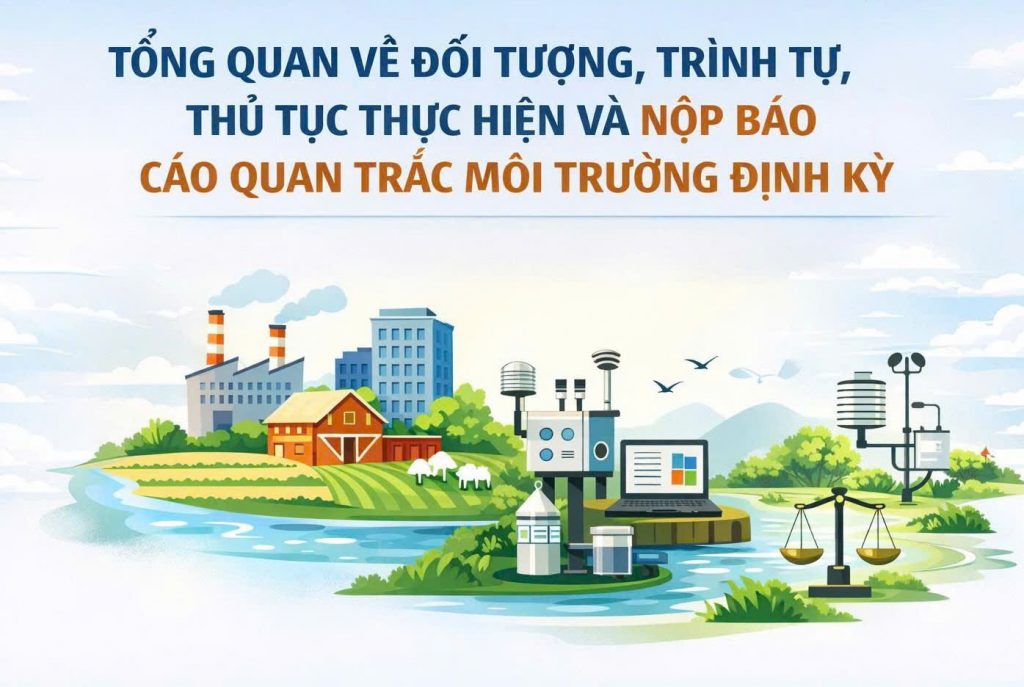
According to the Law on Environmental Protection 2020, periodic environmental monitoring is the activity of measuring, sampling, analyzing, and evaluating environmental components and waste generated from the operation of a facility in order to:
Monitor and control the level of waste generation and treatment;
Assess compliance with National Technical Regulations (QCVN) on the environment;
Providing data to support state management of environmental protection.
Monitoring results are compiled into periodic environmental monitoring reports and submitted to the state management agency as prescribed.
3. Subjects required to conduct periodic environmental monitoring
According to the 2020 Environmental Protection Law, Decree No. 08/2022/ND-CP and Decree No. 05/2025/ND-CP, the following subjects must conduct periodic environmental monitoring:
Production, business, and service establishments subject to environmental permits;
Projects and establishments that generate:
Wastewater;
Emissions;
Noise and vibration;
Hazardous waste;
Essential operating facilities according to approved environmental dossiers;
Essential facilities in industrial parks and clusters as required by the management agency.
👉 The content, parameters, frequency, and location of monitoring are specifically stipulated in the Environmental Permit of each facility.
4. Content of Periodic Environmental Monitoring
Depending on the type of production, business, and scale of waste generation, the content of periodic environmental monitoring may include:
4.1. Wastewater Monitoring
Domestic wastewater;
Industrial wastewater;
Characteristic parameters according to the corresponding National Technical Regulations on Environment.
4.2. Emission Monitoring
Emissions from boilers, chimneys, and production lines;
Pollution parameters according to the National Technical Regulations on Environment.
4.3. Ambient Environmental Monitoring
Ambient air;
Noise;
Vibration;
Total dust.
4.4. Other Environmental Components
Soil, surface water, groundwater (if required in the Environmental Permit).
Environmental monitoring activities must be carried out by a unit that meets the legal requirements for environmental monitoring services.
5. Procedure for conducting periodic environmental monitoring
Step 1: Determining monitoring requirements
Based on the approved environmental permit and environmental dossier;
Clearly define the parameters, locations, frequency, and timing of monitoring.
Step 2: Selecting a monitoring unit
Select a unit with sufficient capacity as prescribed;
Sign a contract for conducting periodic environmental monitoring.
Step 3: Sampling and analysis
Collect samples at the site according to technical procedures;
Analyze samples in a standard laboratory;
Ensure quality control and accuracy of results.
Step 4: Summarizing and evaluating results
Compare monitoring results with corresponding Vietnamese National Technical Regulations (QCVN);
Evaluate the level of compliance and the risk of pollution (if any).
6. Procedures for Preparing and Submitting Periodic Environmental Monitoring Reports
6.1. Report Contents
The periodic environmental monitoring report includes:
General information about the facility;
Legal basis;
Content and methods of monitoring;
Detailed monitoring results (data tables, charts);
Comments and assessment of compliance level;
Recommendations and corrective measures (if any);
Appendix of laboratory analysis results.
6.2. Deadline and Receiving Agency
Reports are submitted according to the frequency stipulated in the Environmental Permit (usually every 6 months or 1 year);
Receiving agency:
Department of Agriculture and Environment;
Industrial Park and Economic Zone Management Board;
Or the agency with delegated management authority;
Submission method: in person, by mail, or through the environmental public service portal (if applicable).
7. Significance and Responsibilities of Businesses
Performing periodic environmental monitoring in accordance with regulations helps businesses:
Comply with the law and reduce the risk of administrative penalties;
Effectively control waste treatment systems;
Proactively prevent environmental incidents;
Contribute to environmental protection and sustainable development.
8. Conclusion
Periodic environmental monitoring and the preparation and submission of reports according to the 2020 Environmental Protection Law and current guiding documents are mandatory obligations for many production, business, and service establishments. Properly implementing the regulations, procedures, and processes not only meets legal requirements but also demonstrates the responsibility of businesses towards the environment and the community.

 Tiếng Việt
 日本語
日本語