

Amidst the complex developments of climate change, plastic pollution remains one of the “white epidemics” challenging the sustainability of the global ecosystem. Entering 2026, the world is witnessing unprecedented efforts to control plastic waste through international treaties and circular economy policies.
1. The overall picture of plastic waste in the world
As of early 2026, the amount of global plastic waste shows no sign of stopping, but management methods have undergone significant changes:
According to a report from the United Nations Environment Programme (UNEP) updated at the end of 2025, the annual global production of new plastic has exceeded 440 million tons. Notably, plastic waste generated from single-use packaging still accounts for the largest proportion (over 40%).
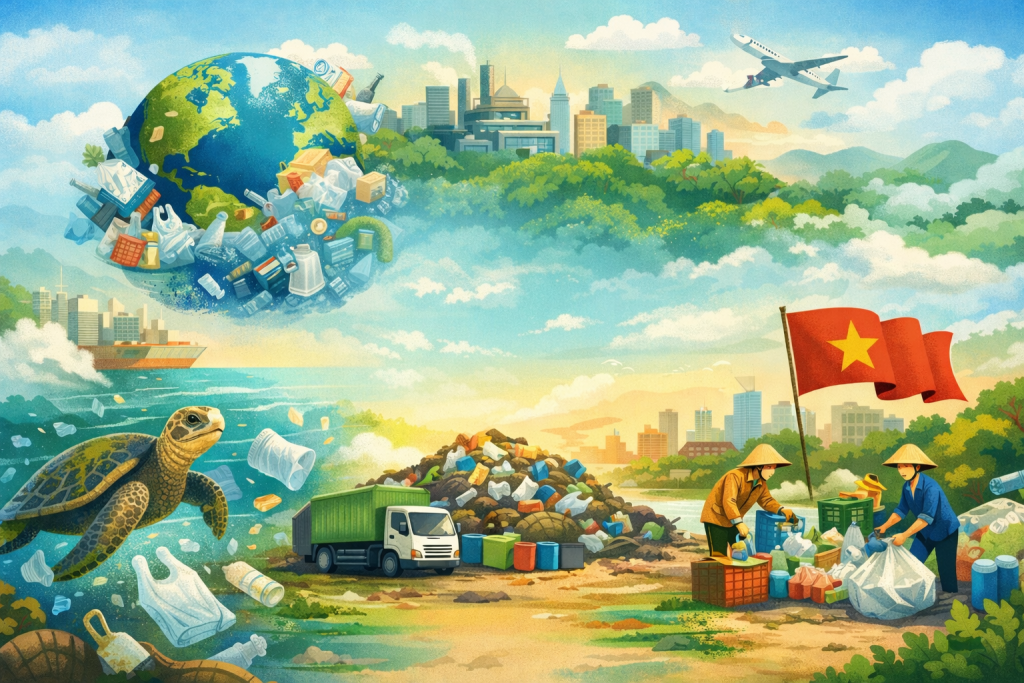
Ocean pollution: Every minute, the equivalent of two truckloads of plastic waste is dumped into the sea. As a result, by 2026, microplastics will have been found in almost every link of the food chain, posing a direct risk to human health.
Policy highlight: The Global Plastic Treaty—initiated by Resolution 5/14 of the United Nations Environment Assembly (UNEA)—is entering a crucial implementation phase, encouraging developed countries to commit to supporting recycling technologies for developing countries.
2. Current status and Vietnam’s efforts in 2026
Vietnam is at a “pivotal” stage in fulfilling its strong environmental commitments.
Generation: With rapid urbanization, Vietnam generates approximately 2 million tons of plastic waste annually. However, a new development in 2026 is the change in waste composition thanks to regulations banning non-biodegradable plastic bags in modern supermarkets.
A milestone in waste sorting at source: After more than a year of mandatory implementation (from January 1, 2025) under the 2020 Environmental Protection Law, the rate of plastic waste sorting in major cities such as Hanoi and Ho Chi Minh City has significantly improved. Preliminary survey data from the Ministry of Natural Resources and Environment (MONRE) published at the end of 2025 shows that the percentage of households sorting waste at source in central districts has increased from less than 10% to about 30-40%, creating a more stable source of raw materials for recycling plants.
Management Indicators: The rate of plastic waste collection and treatment in Vietnam is gradually approaching the target of 85% by 2025. By early 2026, the actual collection rate is estimated to reach approximately 70-75% of the total waste generated (data from reports by the Ministry of Natural Resources and Environment and the World Bank).
Circular economy models, where plastic is considered a resource, are being actively promoted by SOLEN and its partner organizations through consulting solutions for businesses.
3. Solution Trends and the Role of Consulting Organizations
To solve the plastic waste problem in 2026, it’s not enough to just clean up; intervention at the root is needed:
Eco-design: Replacing virgin plastic with recycled plastic and sustainable bio-materials.
Extended Producer Responsibility (EPR): This is a mandatory regulation under Articles 54 and 55 of the 2020 Environmental Protection Law.
By 2026, according to the roadmap in Decree 08/2022/ND-CP and detailed guidance on recycling cost (Fs) in Decree 05/2025/ND-CP, manufacturers and importers of plastic packaging (such as PET, HDPE, LDPE, mixed plastics, etc.) are required to fulfill their recycling responsibilities or contribute financially to the Vietnam Environmental Protection Fund to support recycling.
Compliance with EPR is no longer voluntary but has become a prerequisite for businesses to maintain their supply chain and brand reputation.
Digital technology in waste management: Applying IoT and AI to monitor the flow of plastic waste from generation to recycling.
Conclusion:
Plastic pollution is no longer a problem unique to any one country. In Vietnam, 2026 marks a turning point as communities and businesses join hands to act for a sustainable future.
SOLEN is committed to partnering with organizations in providing optimal environmental management solutions, supporting compliance with EPR regulations, and aiming for green development goals.
References:
United Nations Environment Programme (UNEP) – Plastic Pollution Reports
World Bank Vietnam – Market Study for Plastics Circularity
Ministry of Natural Resources and Environment (MONRE) – National Environmental Status Report
Vietnam’s Environmental Protection Law 2020 and guiding decrees.

 Tiếng Việt
 日本語
日本語