


Abstract
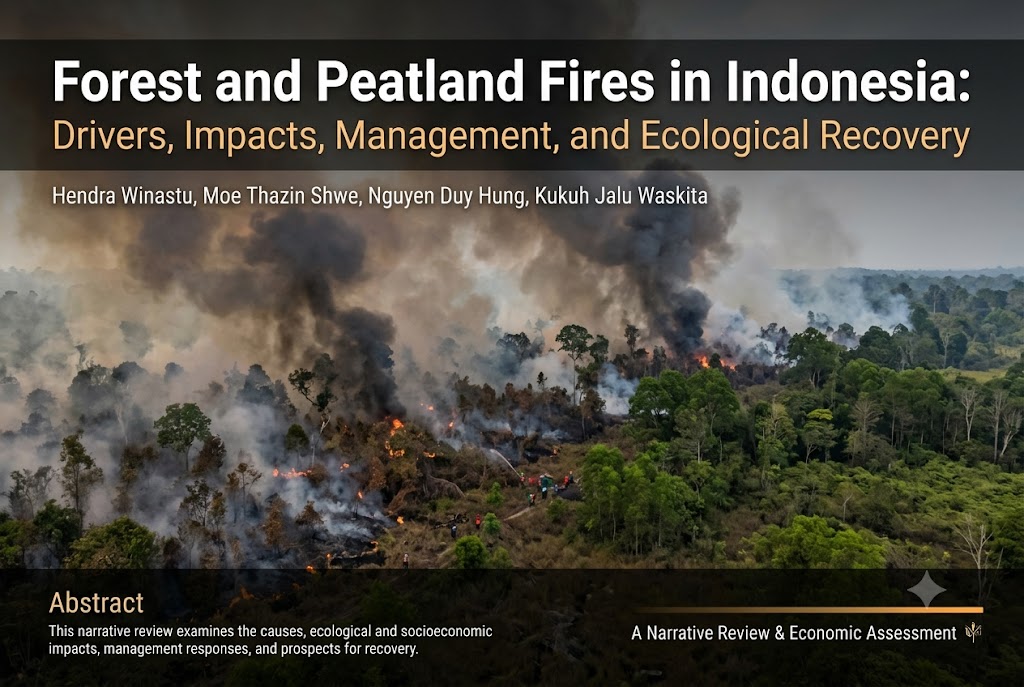
Forest and peatland fires in Indonesia are shaped by land clearing, peatland drainage, drought, and weaknesses in land management and governance. This narrative review examines their causes, ecological and socioeconomic impacts, management responses, and prospects for recovery. Studies of major fire episodes show that drought worsens fire conditions in landscapes already affected by drainage and vegetation disturbance. In peatlands, fires can spread below ground, consuming accumulated organic material and producing prolonged smoke pollution. The resulting damage extends beyond burned areas through habitat loss, carbon emissions, disruption of livelihoods and public services, and adverse health effects. An investigation by WALHI draws attention to corporate affiliations, gaps in ownership information, and hotspots in state-led development areas. These findings identify matters requiring further investigation but do not, on their own, establish fire causation or legal liability. Although vegetation may return after fire, this does not necessarily mean that forest structure, species composition, or ecological function has recovered. Effective management requires sustained attention to ignition prevention, peatland hydrology, community participation, and institutional responsibilities. Recovery also depends on preventing repeated burning and maintaining the conditions needed for forest regeneration.
Keywords: corporate governance; ecological recovery; forest fire; Indonesia; peatland restoration; smoke pollution; socioeconomic impacts.
1. Introduction
Forest and peatland fires cause substantial environmental, social, and economic damage in Indonesia. In Sumatra and Kalimantan, land clearing with fire, forest degradation, and peatland drainage have made many landscapes more susceptible to burning. During Prolonged dry periods, fires can spread widely and produce smoke that affects areas far beyond the fire sites. Severe fire seasons often coincide with drought, but drought alone does not explain where fires begin or how they spread. Ignition sources, land-use practices, and landscape conditions also play an important role (Field et al., 2016; Page & Hooijer, 2016).
This paper reviews selected research publications, an institutional economic assessment, and a civil-society investigation. It examines fire drivers, ecological and socioeconomic impacts, management responses, and post-fire recovery. The paper is a narrative review, not a systematic review or an original analysis of fire records.
Alongside the ecological literature, WALHI’s investigation provides a perspective on corporate affiliations, concession management, ownership transparency, and institutional accountability (WALHI, 2026). Its findings are presented as attributed investigative evidence, not as independently established proof of fire causation or legal responsibility.
Particular attention is given to peatlands, where hydrology, below-ground carbon storage, and combustion differ from conditions in forests on mineral soils. Findings from peatland studies should therefore not be assumed to apply to all Indonesian forest ecosystems.
2. Drivers and Characteristics of Fire
2.1. Land use and drought
Fire requires both an ignition source and conditions that allow it to burn and spread. In Indonesian peatlands, drainage lowers moisture levels, while vegetation disturbance leaves combustible material exposed. The use of fire for land preparation provides ignition sources. Drought compounds these conditions by drying vegetation and peat, allowing fires to spread more readily and persist for longer periods (Page & Hooijer, 2016).
Field et al. (2016) found a nonlinear relationship between declining dry-season rainfall and increasing fire activity and smoke pollution during the 2015 fire season. Once conditions were already dry, further rainfall deficits were associated with disproportionately greater fire activity. Drought therefore amplifies the risks created by drainage and land disturbance, but it does not explain the source of ignition.
2.2. Peat combustion and persistent fire
Peatland fires can burn both surface vegetation and the organic soil beneath it. When Drainage lowers the water table, peat dries and becomes susceptible to smoldering combustion. Once established below ground, a fire may persist for an extended period and can be difficult to extinguish. It also releases carbon that has accumulated over centuries to millennia (Turetsky et al., 2015; Page & Hooijer, 2016).
The extent of a Burned area does not, by itself, indicate the scale of peat loss or carbon emissions. These also depend on how deeply the fire burns and the characteristics of the peat consumed. Assessments therefore need to distinguish fire extent from fire severity, including the amount of below-ground material lost (Page & Hooijer, 2016).
2.3. Concession management and corporate governance
Land-management decisions and governance arrangements influence the conditions in which fires occur. WALHI (2026) investigated 30 concession-holding companies selected for their high recorded hotspot counts: 15 oil palm plantation companies and 15 forestry permit holders. The investigation combined satellite hotspot records and concession-boundary overlays with company records and other secondary information. It identified affiliations linking several concession holders to larger business groups.
These findings raise questions about how fire prevention and land-management decisions are organized across affiliated companies. However, a hotspot within a concession does not establish who started a fire, whether the burning was intentional, or whether the concession holder failed to meet its obligations.
WALHI’s analysis is therefore useful for identifying locations and corporate relationships that warrant further investigation. Establishing responsibility would require evidence on fire origin and spread, land occupation, prevention measures, management decisions, and the response to detected fires. The report also contains inconsistencies in some aggregate hotspot and affiliation totals and uses different reporting periods. Those aggregate figures are not used in this review (WALHI, 2026).
3. Ecological Impacts
Fire changes forest structure, species composition, habitat conditions, and carbon storage. In peat swamp forests, severe fires can destroy vegetation and consume the organic substrate on which it grows. Repeated burning can replace forest with fern- and sedge-dominated vegetation, restricting tree regeneration and leaving the area vulnerable to further fires (Page & Hooijer, 2016).
Long-term Research in Sebangau, Central Kalimantan, shows that these effects can persist well beyond the initial fire. Drawing on 16 years of ecological observations, Harrison et al. (2024) documented changes in ecosystem properties and biodiversity in burned areas and in forests exposed to fire in the surrounding landscape. Vegetation had begun to recover in Burned areas, but forest structure and tree diversity remained impaired relative to unburned forest. The return of vegetation cover was not equivalent to recovery of the original forest.
WALHI’s field investigations also reported fires within or near areas designated for conservation in production landscapes. In Riau, the report described an approximately 71.9 ha fire in swamp forest within a greenbelt in PT Riau Andalan Pulp and Paper’s operational area. WALHI placed the affected area in the transition zone of the Giam Siak Kecil–Bukit Batu Biosphere Reserve and raised concerns about possible effects on protected wildlife. It also reported burning near an area marked as having High Conservation Value in the vicinity of PT Arara Abadi’s concession (WALHI, 2026).
These observations show why the ecological setting of a fire matters alongside its size. Burning in or near conservation areas may require particular attention, but the reported observations do not quantify wildlife mortality or establish population-level effects. Research on Bornean orangutans in Central Kalimantan illustrates how fire and smoke can affect wildlife beyond the immediate loss of habitat. Erb et al. (2018) documented changes in activity and energy balance associated with wildfire smoke, while Hasan and Atmoko (2025) reported reduced fruit availability and changes in orangutan home ranges following a forest fire.
Peat fires also affect areas beyond the burned habitat. Combustion releases stored carbon, while smoke transports pollutants over considerable distances. local forest and peat degradation therefore contributes to regional air pollution and wider climatic impacts (Turetsky et al., 2015; Page & Hooijer, 2016).
4. Socioeconomic Impacts
Forest and peatland fires damage productive assets, interrupt economic activity, and harm public health. The World Bank assessment of Indonesia’s 2015 fire crisis estimated at least US$16.1 billion in damage and losses, equivalent to approximately 1.9% of GDP that year. The assessment covered agriculture, forestry, trade, tourism, transportation, and selected health and education costs. This figure describes damage and losses from a particular event; it is neither an annual average nor a measured reduction in GDP (Glauber et al., 2016). The full costs may be higher when broader ecological and social impacts are taken into account, particularly those that are difficult to quantify or express in monetary terms.
During the 2015 crisis, smoke disrupted transport and commercial activity and forced schools to close. Damage to agricultural and forestry assets also affected local livelihoods. The costs were not evenly shared. A relatively limited group benefited from fire-related land conversion, while a much larger population experienced smoke exposure and economic disruption (Glauber et al., 2016).
Some Health effects may remain detectable long after the smoke has cleared. Using longitudinal household survey data, Kim et al. (2017) found adverse health effects associated with exposure to pollution from the 1997 fires that were still evident a decade later. These findings relate to a specific historical event and cannot be transferred directly to later fire seasons. They nevertheless show that estimates limited to immediate medical costs and short-term disruption may overlook longer-term consequences.
5. Policy and Mitigation Strategies
5.1. Peatland protection and hydrological restoration
Government Regulation No. 71/2014, as amended by Government Regulation No. 57/2016, provides a framework for protecting and managing peat ecosystems. Its provisions cover ecosystem assessment, management planning, and restoration (Republic of Indonesia, 2016).
In drained peatlands, prevention must address both ignition sources and the drying of peat. Hydrological restoration seeks to restore and maintain wet conditions, while protecting remaining peat swamp forest helps avoid further degradation. These measures address the conditions that allow peat to burn, rather than relying on suppression after a fire has become established (Page & Hooijer, 2016).
5.2. Community participation and implementation capacity
Restrictions on burning are more workable when land users have affordable alternatives for preparing land. Technical assistance and livelihood support can help make those alternatives feasible. Community involvement also requires reliable funding, equipment, and institutional support. it should complement, rather than replace, the obligations of government and other responsible institutions (Page & Hooijer, 2016; Nurhidayah et al., 2023).
a study of six villages in Riau and Central Kalimantan identified inadequate funding for community fire brigades and maintenance of rewetting infrastructure as important constraints. Limited access to affordable alternatives to burning created further difficulties (Nurhidayah et al., 2023).
The study illustrates the gap that can arise between regulatory requirements and local capacity to implement them. Its findings support the need for operational resources and locally feasible land-management practices, although they do not provide a nationally representative assessment of program performance.
5.3. Ownership transparency and corporate accountability
Concession oversight requires clarity about the permit holder and the parties that control management decisions. WALHI (2026) traced corporate affiliations and ownership structures for 20 companies in its hotspot-selected sample and two additional companies investigated following reported fires. For the remaining ten companies in the sample, ownership, management, or beneficial-owner information could not be adequately established. The report attributed these gaps to limited disclosure by private companies and incomplete publicly accessible corporate information.
Information on parent companies, controlling shareholders, and beneficial owners can help investigators identify where operational authority and financial decisions reside. Ownership links alone, however, do not establish control over the activities associated with a particular fire. Shareholding, business-group affiliation, and operational responsibility need to be examined separately.
Investigations should therefore consider evidence of actual decision-making, including responsibility for land preparation, drainage, fire-prevention budgets, and operational supervision. Liability should not be presumed solely from a company’s affiliation with a wider business group (WALHI, 2026).
In practice, concession oversight should link environmental performance records with verified corporate information. Repeated fire indications across affiliated concessions may warrant coordinated investigation into prevention arrangements across the group. Any administrative action or legal proceedings must still rest on verified evidence and the applicable legal requirements.
5.4. Accountability in state-led development areas
WALHI’s assessment of the Food and Energy National Strategic Project area in Merauke extends the issue of accountability beyond private concessions. Its spatial analysis identified hotspots in corporate project areas and in development clusters described as managed or coordinated by government institutions (WALHI, 2026).
Fire-risk assessment in such settings needs to consider the wider development landscape, including public agencies, concession holders, and contractors involved in land clearing. Where several institutions share responsibilities, prevention arrangements should specify who authorizes land preparation, maintains prevention infrastructure, responds to fires, and carries out restoration.
WALHI also stated that any direct relationship between particular contractor activities and specific hotspots required further field verification. The finding therefore points to the need for clear, verifiable responsibilities; hotspot location alone does not establish who was responsible for burning (WALHI, 2026).
6. Ecological Recovery and Restoration
Post-fire recovery involves more than the return of vegetation. forest structure, species composition, and ecosystem function may recover at different rates. In peat swamp forests, recovery depends on fire severity, the frequency of subsequent burning, hydrological conditions, and the presence of surviving trees and seed sources. Repeated fire can interrupt succession and favor vegetation that limits tree recruitment (Harrison et al., 2024).
Natural regeneration can restore some woody vegetation where further disturbance is prevented. In Sebangau, Harrison et al. (2024) observed signs of vegetation recovery over 12 years, but burned forest remained structurally impaired and supported fewer tree species. These observations demonstrate that recovery is possible, but they do not establish a general recovery timescale for Indonesian forests.
Restoration in drained peatlands must address hydrological degradation as well as vegetation loss. Regenerating sites also need protection from further fire, which can reverse recovery and maintain degraded vegetation. Restoration objectives should distinguish the re-establishment of vegetation cover from the recovery of forest composition, structure, and ecological function (Page & Hooijer, 2016; Harrison et al., 2024).
Recovery also requires continuity in management and financing. WALHI (2026) calls for accountability measures that include ecosystem restoration rather than ending with the identification or sanctioning of concession holders. Read alongside the ecological studies, this supports assigning clear responsibility for restoration, funding, and long-term monitoring. Changes in ownership or institutional arrangements should not leave those responsibilities unresolved.
Restoration commitments should state who will carry out the work, which ecological outcomes are expected, and how progress will be assessed. Hydrological restoration and vegetation recovery both require sustained management, not only initial intervention (Page & Hooijer, 2016; Harrison et al., 2024; WALHI, 2026).
Monitoring should reflect the different components of recovery. Planting totals and vegetation cover can indicate establishment, but they provide only part of the picture. Other Relevant indicators include hydrological conditions, seedling recruitment, forest structure, species composition, and forest-associated fauna. Comparison with suitable unburned reference areas can help determine how far recovering sites have regained forest characteristics (Harrison et al., 2024).
7. Conclusion
Drought worsens fire conditions in Indonesia, but ignition, drainage, and land-use practices remain central to the occurrence and spread of forest and peatland fires. Prevention must therefore address the conditions that make landscapes combustible, rather than depend mainly on emergency suppression. protecting remaining peat swamp forests, restoring hydrology in drained peatlands, and supporting practical alternatives to burning are important priorities.
WALHI’s investigation raises questions about corporate affiliations, ownership transparency, and the allocation of responsibilities in state-led development areas. These findings warrant closer examination of the roles of concession holders, controlling entities, public agencies, and contractors. Hotspot records and corporate links can guide that work, but they are not sufficient evidence of causation or legal liability (WALHI, 2026).
Recovery should be judged against explicit ecological objectives. The return of vegetation is encouraging, but it does not establish that forest biodiversity, structure, and function have been restored. Preventing repeated fire, maintaining suitable hydrological conditions, and assigning lasting responsibility for restoration and monitoring are necessary to give regenerating forests a chance to recover.
By: Hendra Winastu, SOLEN Principal Associate – IPC panel coordinator.
Edited: Moe Thazin Shwe, SOLEN Research Associate – IPC panel member; Nguyen Duy Hung, SOLEN Director; Kukuh Jalu Waskita, SOLEN Associate – IPC panel member.
Date: 22/10/2026
Article #: SOLEN-IPC-0036
8. References
Erb, W. M., Barrow, E. J., Hofner, A. N., Utami-Atmoko, S. S., & Vogel, E. R. (2018). Wildfire smoke impacts activity and energetics of wild Bornean orangutans. Scientific Reports, 8, Article 7606. https://doi.org/10.1038/s41598-018-25847-1
Field, R. D., van der Werf, G. R., Fanin, T., Fetzer, E. J., Fuller, R., Jethva, H., Levy, R., Livesey, N. J., Luo, M., Torres, O., & Worden, H. M. (2016). Indonesian fire activity and smoke pollution in 2015 show persistent nonlinear sensitivity to El Niño-induced drought. Proceedings of the National Academy of Sciences, 113(33), 9204–9209. https://doi.org/10.1073/pnas.1524888113
Glauber, A. J., Moyer, S., Adriani, M., & Gunawan, I. (2016). The cost of fire: An economic analysis of Indonesia’s 2015 fire crisis (Indonesia Sustainable Landscapes Knowledge Note No. 1). World Bank. https://hdl.handle.net/10986/23840
Harrison, M. E., Deere, N. J., Imron, M. A., Nasir, D., Adul, Asti, H. A., Aragay Soler, J., Boyd, N. C., Cheyne, S. M., Collins, S. A., D’Arcy, L. J., Erb, W. M., Green, H., Healy, W., Hendri, Holly, B., Houlihan, P. R., Husson, S. J., Iwan, . . . Struebig, M. J. (2024). Impacts of fire and prospects for recovery in a tropical peat forest ecosystem. Proceedings of the National Academy of Sciences, 121(17), Article e2307216121. https://doi.org/10.1073/pnas.2307216121
Hasan, S., & Atmoko, S. S. U. (2025). Changes in the home range of Bornean orangutans (Pongo pygmaeus wurmbii) before and after forest fires at Tuanan Research Station, Central Kalimantan. Journal of Tropical Biodiversity, 6(1), 1–11. https://doi.org/10.59689/bio.v6i1.324
Kim, Y., Knowles, S., Manley, J., & Radoias, V. (2017). Long-run health consequences of air pollution: Evidence from Indonesia’s forest fires of 1997. Economics & Human Biology, 26, 186–198. https://doi.org/10.1016/j.ehb.2017.03.006
Nurhidayah, L., Astuti, R., Hidayat, H., & Siburian, R. (2023). Community-based fire management and peatland restoration in Indonesia. In A. Triyanti, M. Indrawan, L. Nurhidayah, & M. A. Marfai (Eds.), Environmental governance in Indonesia (pp. 135–150). Springer. https://doi.org/10.1007/978-3-031-15904-6_8
Page, S. E., & Hooijer, A. (2016). In the line of fire: The peatlands of Southeast Asia. Philosophical Transactions of the Royal Society B: Biological Sciences, 371(1696), Article 20150176. https://doi.org/10.1098/rstb.2015.0176
Republic of Indonesia. (2016). Government Regulation No. 57 of 2016 amending Government Regulation No. 71 of 2014 concerning the protection and management of peat ecosystems.
Turetsky, M. R., Benscoter, B., Page, S., Rein, G., van der Werf, G. R., & Watts, A. (2015). Global vulnerability of peatlands to fire and carbon loss. Nature Geoscience, 8, 11–14. https://doi.org/10.1038/ngeo2325
Wahana Lingkungan Hidup Indonesia. (2026). Who are behind the fires? Tracing the capital, power, and business group affiliations behind the companies with the highest indications of forest and land fires. Eksekutif Nasional WALHI.

 Tiếng Việt
 日本語
