


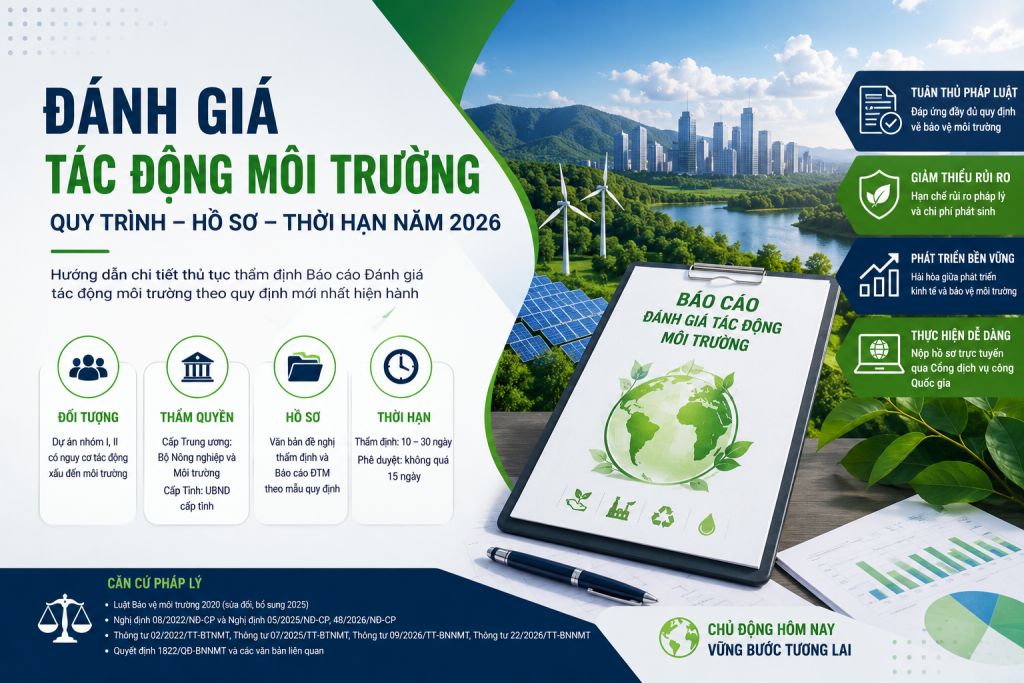
As Vietnam’s environmental legal framework continues to evolve toward greater decentralization, administrative simplification, and enhanced regulatory efficiency, the Environmental Impact Assessment (EIA) appraisal procedure remains one of the most important legal requirements for investment projects nationwide.
The year 2026 introduces several notable changes concerning competent authorities, processing timelines, application dossiers, and implementation procedures under the Law on Environmental Protection 2020, the amended legislation of 2025, and newly issued decrees and circulars. Understanding these regulations is essential not only for legal compliance but also for minimizing risks during project implementation.
What is an Environmental Impact Assessment?
An Environmental Impact Assessment (EIA) is a process of analyzing, forecasting, and evaluating the potential impacts of an investment project on the natural and social environment before project implementation.
Based on the assessment results, project owners are required to propose pollution prevention measures, environmental protection solutions, and environmental incident response plans throughout the project’s lifecycle.
The approved EIA report serves as an important legal basis for authorities to consider project implementation and to monitor compliance with environmental commitments during both construction and operation phases.
Which Projects Must Conduct an EIA?
Under current regulations, investment projects with a high potential for environmental impacts must conduct an EIA before implementation.
At the provincial level, the primary subjects include Group I projects and certain Group II projects involving environmentally sensitive factors, such as large-scale land-use projects, mineral extraction activities, water resource exploitation, land-use conversion, or projects requiring relocation and resettlement.
At the central-government level, the scope includes large-scale and complex projects such as nuclear power plants, sea reclamation projects, major mining projects, projects utilizing 50 hectares or more of land, projects approved by the National Assembly or the Prime Minister, industrial parks, and projects with a high risk of environmental pollution.
Conversely, certain emergency public investment projects and legally exempted cases are not required to conduct an EIA.
Distinguishing EIA Appraisal Authority Between Central and Provincial Levels
One of the most important issues for investors is determining the correct appraisal authority.
For projects under local jurisdiction, the competent authority is the Provincial People’s Committee. The appraisal process is typically carried out by specialized agencies assigned by the provincial government.
For large-scale, inter-provincial, or nationally significant projects, the appraisal authority belongs to the Ministry of Agriculture and Environment. Projects involving national defense and security secrets are appraised by the Ministry of National Defense or the Ministry of Public Security under separate regulations.
Determining the correct authority from the outset is crucial because applications submitted to the wrong authority may be rejected, causing delays in project implementation.
EIA Appraisal Procedures in 2026
Although the competent authorities may differ, the appraisal procedures at both central and provincial levels generally follow five main steps.
The first step is dossier submission. Investors may submit applications directly, via postal services, or online through the National Public Service Portal.
After receipt, the appraisal authority reviews the completeness and validity of the dossier and confirms whether the project falls within the scope requiring an EIA.
The next stage involves professional appraisal. Appraisal councils or environmental experts evaluate the report, conduct site inspections when necessary, and assess the project’s compliance with environmental protection requirements.
If the report is conditionally approved, the project owner must revise and supplement the dossier within a maximum period of 12 months from receiving the appraisal result notification.
Finally, the competent authority issues an approval decision or a rejection notice and returns the results to the applicant through the selected method.
Required Application Documents
According to the latest regulations, an EIA appraisal dossier consists of two primary components.
The first is an official application requesting appraisal of the Environmental Impact Assessment Report.
The second is the Environmental Impact Assessment Report prepared in accordance with the standard templates issued by the Ministry of Agriculture and Environment.
If revisions are required following the appraisal council meeting, investors must additionally submit a request for approval of the appraisal results along with the revised EIA report.
Currently, only one complete dossier is required, making the procedure more convenient than in previous years.
Main Contents of an EIA Report
A comprehensive EIA report must provide detailed information regarding project scale, location, technology, and construction components.
It must also assess all potential environmental impacts, including wastewater, emissions, solid waste, hazardous waste, noise, and vibration during both construction and operational phases.
In addition, project owners must propose environmental protection measures such as wastewater treatment systems, emission control systems, solid waste management plans, environmental monitoring programs, emergency response plans, and other relevant mitigation measures.
Projects involving mining activities or biodiversity-sensitive areas may also be required to include environmental restoration plans, restoration deposits, and biodiversity compensation measures.
Processing Time in 2026
From July 1, 2026, EIA appraisal timelines become more streamlined and standardized.
Projects under the authority of the Ministry of Agriculture and Environment, the Ministry of National Defense, or the Ministry of Public Security will be appraised within a maximum of 30 working days.
Projects under the authority of Provincial People’s Committee Chairpersons will have a maximum appraisal period of 20 working days.
Special public investment projects benefit from an expedited process with a maximum appraisal period of 10 working days.
Following the submission of a complete and valid dossier, the competent authority must issue an approval decision within 15 working days.
EIA Appraisal Fees
EIA appraisal fees vary significantly among localities.
In Hanoi, fees range from approximately VND 8 million to VND 61 million depending on project scale. Other provinces such as Lao Cai, Son La, and Binh Thuan may impose considerably higher fees for large-scale projects.
Several provinces are encouraging digital transformation by waiving or reducing fees for online submissions. Hai Phong, Lang Son, Ninh Thuan, and Lam Dong are among the localities currently implementing such incentives.
For centrally appraised projects, fees are determined based on total investment capital and project classification in accordance with regulations issued by the Ministry of Finance.
New Trends: Greater Decentralization and Digital Transformation
The regulatory changes introduced in 2026 demonstrate a clear trend toward stronger decentralization, streamlined administrative procedures, and expanded online public services.
Reducing processing times, standardizing application forms, and promoting digital submissions not only improve administrative efficiency but also help businesses save significant time and costs.
As environmental requirements become increasingly stringent, preparing a complete and compliant EIA dossier at the project planning stage is essential for ensuring smooth implementation, minimizing legal risks, and supporting long-term sustainable development.
For more information, please refer to:
- Summary Report on Environmental Impact Assessment Dossier Preparation – Provincial Level
- Summary Report on Environmental Impact Assessment Dossier Preparation – Central Government Level

 Tiếng Việt
 日本語
日本語